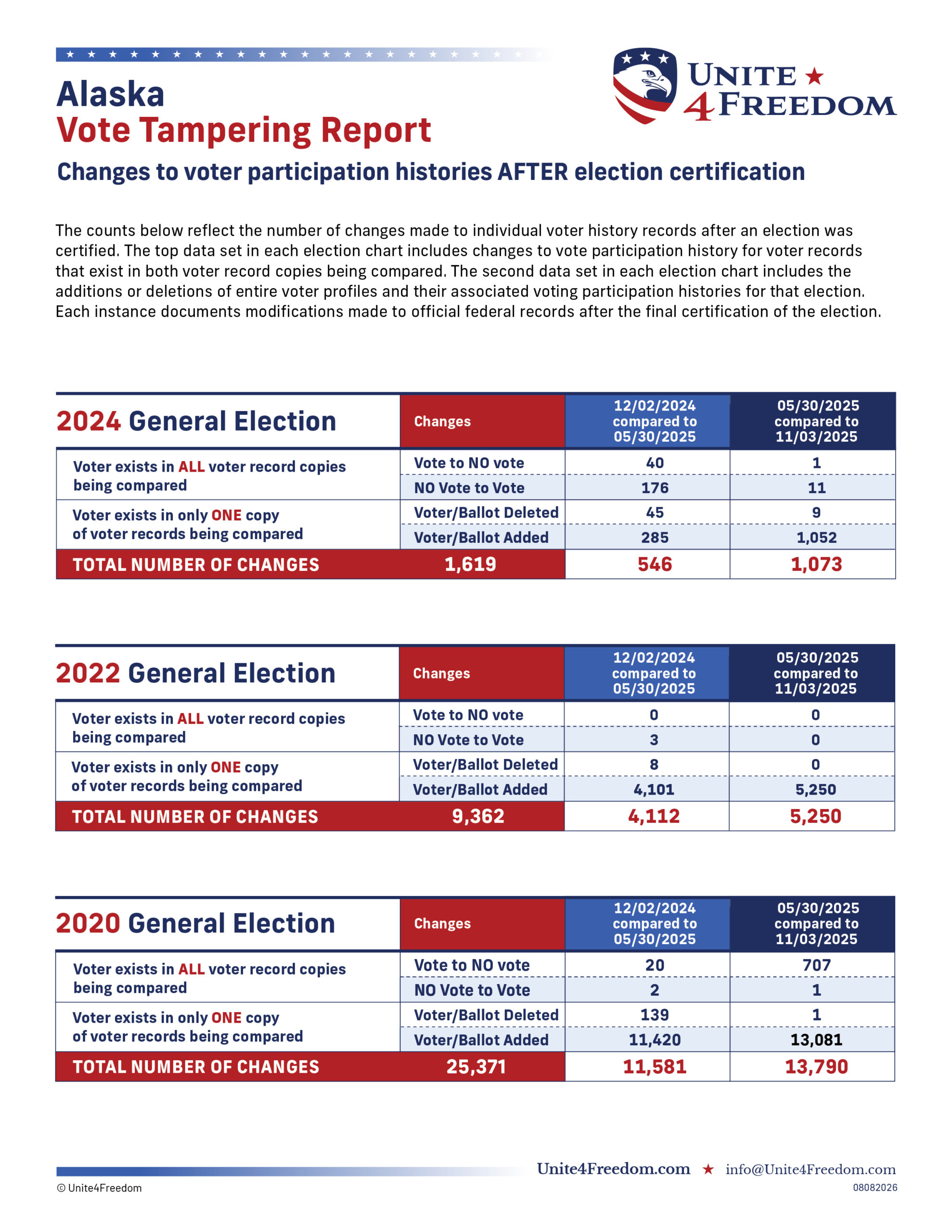
Unite4Freedom (U4F) released its Alaska Vote Tampering Report today. U4F analysts compared voter participation history from multiple timestamped snapshots of Alaska’s official voter records. The report focuses on changes made after election certification and after official election records should have been preserved and maintained. The voter participation history changes affect the 2020, 2022, and 2024 federal election cycles.
What do the reports show?
The analysis compared three snapshots of data (December 2, 2024 to May 30, 2025 and then May 30, 2025 to November 3, 2025) across the last three federal election cycles, and found the following types of changes:
- Vote → No vote
- No vote → Vote
- Voter and participation history present in first snapshot, missing in the second
- Voter absent in the first snapshot, present with a participation history for the election in the second
In 2024, there were 1,619 changes made.
In 2022, there were 9,362 changes made.
In 2020, there were 25,371 changes made.
These findings raise a fundamental question
If election results were accurate when certified, why are voter histories associated with those certified elections continuing to change years later?
Under both federal and state law, election officials certify election results as accurate. Certification represents an official declaration that election processes were completed, ballots were counted, and results are correct.
Either election officials certified records that were not accurate at the time certification occurred, or changes were made to official federal election records after certification. There is not a third option! The records changed, and election officials must explain why.
“What exactly did Alaska certify?” asks U4F Chairman, Harry Haury. “Election certification is supposed to be a final statement that election records are accurate. Certified election records should not change after the election is over. Citizens are entitled to transparency, accountability, and proof that election results are accurate and election records are accurate at the time of certification and don’t change after certification.
Alleged federal requirements at issue
- Maintenance of an accurate, official statewide voter-registration list. (52 USC § 21083(a)(1), (a)(4))
- Retention of records sufficient to explain any discrepancy between the certified ballot count and participation history. (52 USC § 20701, 22-month federal retention requirement)
- Provision of an audit trail—date, requester, reason, authority, and reconciliation effect—for post-certification changes. (52 USC § 21083(a)(1)(A), (a)(2))
- Maintenance of election records in complete, auditable form, retained either directly by election officials or under their direct administrative supervision. (US Dept. of Justice, Civil Rights Div., Federal Law Constraints on Post-Election “Audits” (Apr. 2024), interpreting 52 USC §§ 20701–20706)
Federal elections must follow federal law
The Help America Vote Act requires states to maintain a single, uniform, official statewide voter registration list containing every legally registered voter, while federal record-retention laws require preservation of election records sufficient to document the results and conduct of federal elections.
The Alaska report is part of a broader national series examining election records maintained by state election officials. Similar analyses conducted by Unite4Freedom have identified post-certification record changes in multiple other states as well.
U4F is calling on Alaska election officials to publicly explain:
- Why do certified voter history records continue to change years after the elections?
- Who authorized those changes, under what authority, and where are the records that demonstrate those changes?
- What controls exist to prevent unauthorized modification of election records?
- How can citizens have confidence in the result of their elections and independently verify that certified election records are accurate and complete?
The complete Alaska Vote Tampering Report along with those of additional states are available at unite4freedom.com/reports/vote-tampering-reports/.
Beyond Alaska
in voter-registration and voter-history data. The results are summarized in our State Election Validity Scorecards. In addition to apparent violations in registration and voting, these reports show that there is not one state where the certified election tally (ballots counted) matches the number of voters recorded as having voted in the election.
Our research has been used in multiple federal lawsuits, and we intend to continue publishing reports and pursuing legal and legislative remedies based on our findings.
“Valid elections are guaranteed in the Constitution and are the foundation of our Republic,“ says Haury. “Citizens have a right to demand accuracy. If elections are not accurate, then who is ultimately selecting our representatives?”
Additional state reports are available at Unite4Freedom.com/reports.